Our priority hinges on good governance that permeates throughout the organisation, responsible stewardship in upholding core values, care for our people and a keen focus in protecting our environment.
Over the years, our organisation has established a sustainability policy, put governance structures in place and aligned our efforts with the UN SDGs making tremendous progress in our sustainable framework. SAMEE is well-positioned to continue contributing favourably to sustainability initiatives in the future by concentrating on EESG concerns and improving its sustainability content. Currently, we express our values explicitly through our inclusion of the sustainability journey within the EESG framework.
The sustainability pillars form the foundation of SAMEE Group’s Sustainability Policy (“Policy”) and we focus priority on governance considerations to reinforce our commitment to sustainability. The focus is on integrating economic, environmental, social and governance elements into our daily operations while coordinating our actions with sustainability objectives in mind. In terms of approach and efforts, we ensure that all our internal stakeholders are aware of our commitment to sustainability. For this reason, we have integrated our sustainability approach and initiatives into our orientation programme for our new employees to ensure we have a consistent and shared understanding of the sustainability initiatives and measures embraced by SAMEE. We promote our sustainability principle and practices among our leaders, internal and external stakeholders to achieve our sustainable goals.
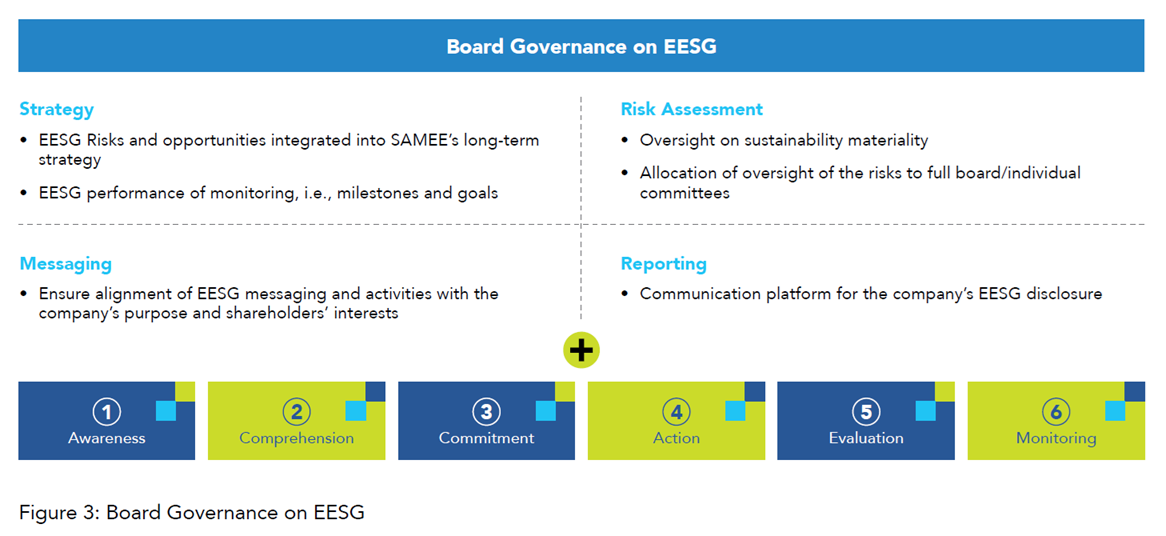
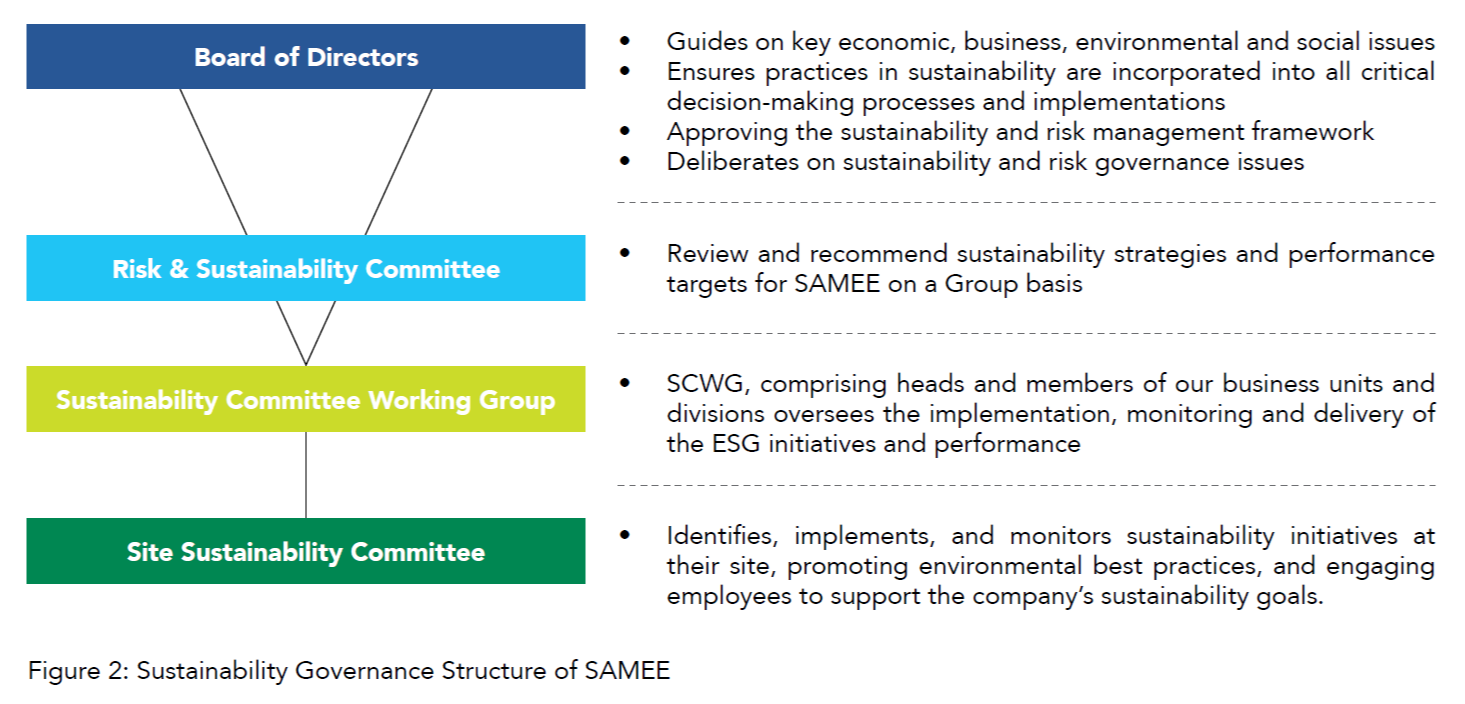
SAMEE has instituted a robust sustainability governance structure to ensure that sustainability principles are effectively embedded into the Group’s strategic direction, risk management, and operational execution. This structure reflects the Board’s commitment to longterm value creation and responsible business practices.
At the apex of the governance framework is the Board of Directors, which bears ultimate accountability for the oversight of sustainability matters. The Board plays a central role in ensuring that material sustainability risks and opportunities are identified, monitored, and integrated into the Group’s overall strategies and business model. It is responsible for setting the tone from the top and ensuring that sustainability remains a key consideration in the Group’s decision-making processes.
Reporting directly to the Board is the Risk and Sustainability Committee (“RSC”), a Board-level committee entrusted with the oversight of both risk management and sustainability. The RSC is tasked with reviewing and recommending the Group’s sustainability strategies, policies, and performance indicators. It ensures that the Group’s sustainability-related commitments, including those related to climate change, resource efficiency, human capital, and stakeholder engagement, are implemented with rigour and consistency. The RSC also reviews the Group’s Sustainability Policy, evaluates the effectiveness of sustainability practices, and oversees the preparation of sustainability disclosures. The Committee convenes on a quarterly basis to deliberate on key sustainability issues and submits our findings and recommendations to the Board for consideration.
Operational execution is led by the Sustainability Committee Working Group (“SCWG”), which comprises cross-functional representatives from key business units and corporate functions and meets monthly. This working group is responsible for implementing the approved sustainability strategies, collecting and validating sustainability-related data, managing internal assessments, and coordinating stakeholder engagement activities. It plays a critical role in ensuring that the Group’s sustainability performance is monitored, and that reporting is consistent with internal controls and external expectations.
At the operational level, SAMEE Group has also established Site Sustainability Committees at each business unit or site. These site-level Committees are tasked with translating group-wide sustainability strategies into actionable initiatives tailored to local contexts. They are responsible for driving the onthe- ground implementation of sustainability efforts, monitoring site-specific performance, and reporting progress to the SCWG. In doing so, the Site Sustainability Committees actively engage employees and local communities to raise awareness and foster participation in the Group’s sustainability journey.
This integrated, tiered governance structure ensures strong alignment between Board-level oversight and operational implementation, enabling SAMEE Group to drive continuous improvement in its sustainability performance while maintaining transparency and accountability to all stakeholders. It reinforces SAMEE Group’s dedication to upholding sound corporate governance, adhering to high ethical standards, and complying with all applicable laws and regulations across the jurisdictions in which we operate. Through this governance framework, we strive to deliver shared value by engaging employees, partners, shareholders, government agencies, customers, communities, and the media in advancing our sustainability objectives.
SAMEE Group maintains consistent communication with our stakeholders through diverse channels to identify their primary concerns and gain insight into potential solutions. In addition to guiding our disclosure and reporting strategies, stakeholder feedback supports our materiality assessment.
As we navigate the ever-evolving landscape of sustainability, stakeholder engagement remains the cornerstone of our journey. We recognise that our success is inextricably linked to the voices and perspectives of those who invest in our mission, rely on our services and share our vision for a more responsible future. In FY2025, we rolled out a materiality survey to our internal and external stakeholders. The stakeholders were asked to assess the importance of SAMEE Group’s 14 Material Topics that reflect the feedback received during stakeholder engagement sessions.
From the assessment, we were able to assess the significance of each stakeholder group by determining their influence and dependency, which weightage was then reflected in the materiality matrix. The prioritisation of stakeholders is important as it indicates how significant a stakeholder group is to SAMEE Group, which would then allow us to understand how a sustainability matter may be material. The matrix below indicates that SAMEE Group needs to have especially robust engagements with about half of our stakeholders.
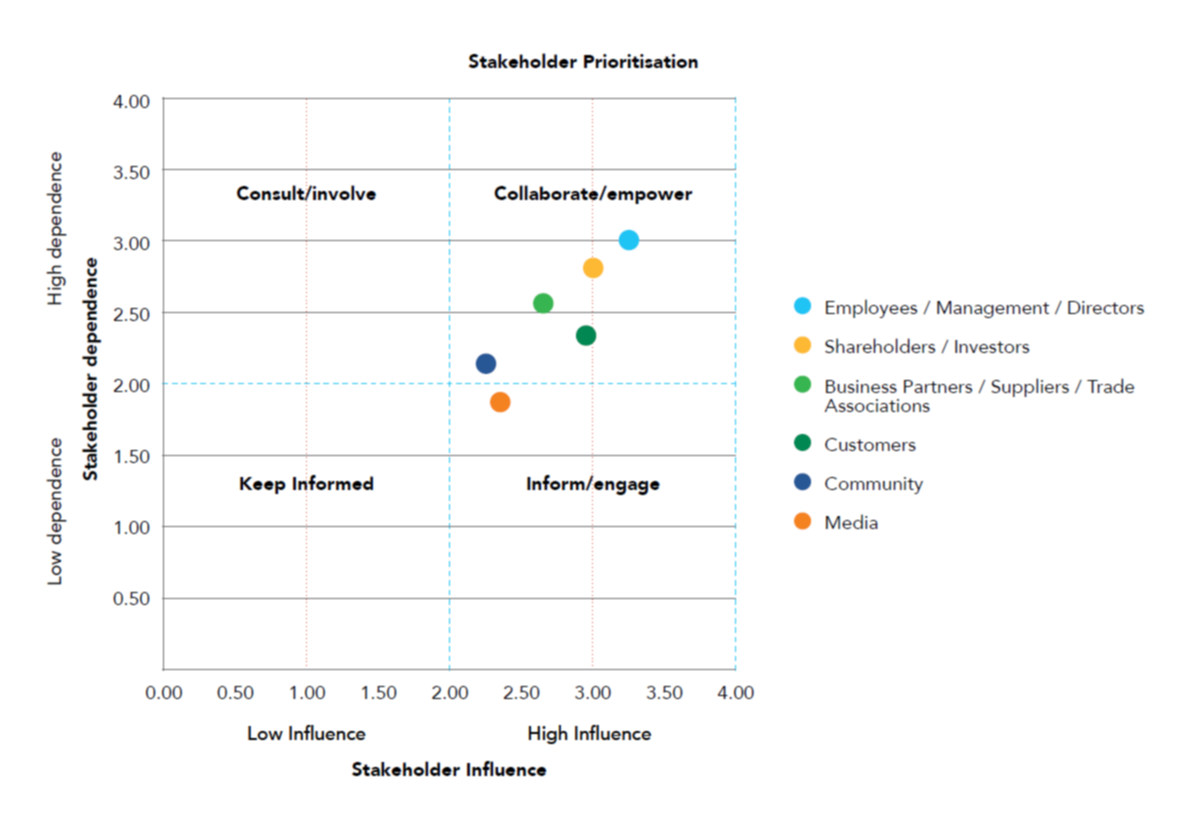
Engaging with our stakeholders is fundamental to our sustainability strategies. By maintaining continuous and inclusive dialogues with key groups, including Employees / Management / Directors, Shareholders / Investors, Customers, Business Partners / Suppliers / Trade Associations, Community, Regulators, Media. We gain valuable insights that inform our decision-making processes. This collaborative approach enables us to address industry challenges effectively and adapt to the evolving landscape. Through proactive stakeholder engagement, we identify areas where we can make the most significant impact and uncover opportunities for improvement. This ongoing interaction ensures that our sustainability initiatives are aligned with stakeholder expectations and contribute to our overarching goal of sustainable growth and operational excellence.
Sub-Group
Shareholders/Investors/Financial Institutions
Engagement Channels
• Periodic Bursa announcements
• Analysts/fund managers presentations and briefing
• Analyst reports on SAMEE
• Annual General Meeting
• SAMEE Group Annual Report
Level of Engagement
Collaborate/Empower
Area of Interest/Concern
• Current and projected growth opportunities and threats
• Funding needs
• Risk management
• Corporate governance
• Sustainability-compliant and initiatives
• Board representation and diversity
Frequency
Annually/Quarterly/Ongoing
Sub-Group
Directors/Management/Permanent staff/Contract staff
Engagement Channels
• Periodic and ad-hoc meetings and interactions
• Workshop discussions
• Weekly coordinating meeting and Weekly operation meeting
• Quarterly employee communication session
• Quarterly management meeting
• Annual Management Retreat/Conference
• Board and Board Committee meetings
• Plant/Factory visits
• Learning and development programmes
• Value Creation Programme
• Corporate volunteering programmes
• Induction training
• Employee performance appraisal
• Employee Engagement Surveys
• SAMEE Group eHub App on Smartphones
• HR participates in Career Talks during SAMEE Career Day and career fairs organised by Perkeso and Learning Institutions
Level of Engagement
Collaborate/Empower
Area of Interest/Concern
• Update on the current and future directions of SAMEE
• Update on the current and projected performance of SAMEE
• Opportunities for healthy career growth, upskilling, and learning and development
• Update on the current and future for the working environment, especially on job security, health and safety
• Safeguarding human rights and a humane and respectful workplace environment
Frequency
Annually/Quarterly/Monthly/Weekly/Ongoing
Sub-Group
Customers representatives
Engagement Channels
• Periodic and ad-hoc meetings and interactions
• Periodic and surprise quality control and audit by customers
• Monthly Operation Review
• Quarterly Business Review
• Customer Satisfaction Survey
Level of Engagement
Collaborate/Empower
Area of Interest/Concern
• Product and technology development and collaboration
• Quality and reliability of products and services with assurances
• Projected orders and commitments
• Timeline and timeliness in delivery
• Warranties and claims
• Customer service
• Pricing issues and trends
• International and specific standards and sustainability compliant practices
• Human/labour rights and safety
• Business Continuity Planning on delivery Collection aging/schedule
Frequency
Annually/Quarterly/Monthly/Weekly/Ongoing
Sub-Group
Trade associations/Roundtables
Engagement Channels
• Periodic and ad-hoc meetings and interactions
• Periodic and surprise quality control and audit on suppliers
• Quarterly Business Review
• Participation in suppliers’ Customer Satisfaction Survey
• Trade association participations and meetings
Level of Engagement
Collaborate/Empower
Area of Interest/Concern
• Product and technology development and collaboration
• Quality and reliability of products and services with assurances
• Projected orders and commitments
• Timeline and timeliness in delivery
• Warranties and claims
• Customer service support
• Pricing issues and trends
• International and specific standards and sustainability compliant
• Human/labour rights and safety
• Business Continuity Planning on supply
• Payment aging/schedule
Frequency
Annually/Quarterly/Ongoing
Sub-Group
Health and Safety Department/Department of Environment/Labour Relations
Department/Bursa Malaysia/Securities Commission
Engagement Channels
• On-site inspection
• Safekeeping and availability of records for audit
• Correspondences with regulators
• Dialogues with regulators
• Participation of dialogues and forums
Level of Engagement
Collaborate/Empower
Area of Interest/Concern
• Meeting of all required operating licenses and regulations
• Compliance of all requirements from local councils and authorities (e.g., Department of Occupational Safety and Health (“DOSH”) and Department of Environment (“DOE”)
• Anti-Bribery and Corruption
• Human rights
• Ensuring all employees are protected by all relevant labour laws and requirements
• Hiring of only legitimate foreign workers
• Fair treatment of all employees
• Availability of whistleblowing channels and protection for whistleblower
Frequency
Ongoing
Sub-Group
Local surrounding community/Local government/Local charities
Engagement Channels
• Initiatives and partnerships withNGOs
• Institution/University internship programme
• Corporate volunteering programmes (blood donation, orphanage visit, cleaning and painting event)
Level of Engagement
Collaborate/Empower
Area of Interest/Concern
• Volunteering projects
• Donations in kind and monetary
• Health, safety and environmental initiatives
Frequency
Ongoing
Sub-Group
Social media/Newspapers
Engagement Channels
• Media release
• Media interview
• Press conference
Level of Engagement
Inform/Engage
Area of Interest/Concern
• Financial reporting
• Transparency
• Business continuity
Frequency
Ongoing
In FY2025, SAMEE conducted a comprehensive materiality assessment exercise to ensure the continued relevance of our material sustainability matters. The assessment involved engaging internal and external stakeholders through an online survey to evaluate the priorities and impacts of each material topic. This exercise aimed to reaffirm that the existing 14 material matters remain aligned with SAMEE Group’s strategic priorities and stakeholders’ expectations. The outcomes of this process are presented in the following materiality matrix, categorising each topic based on our level of significance and influence.
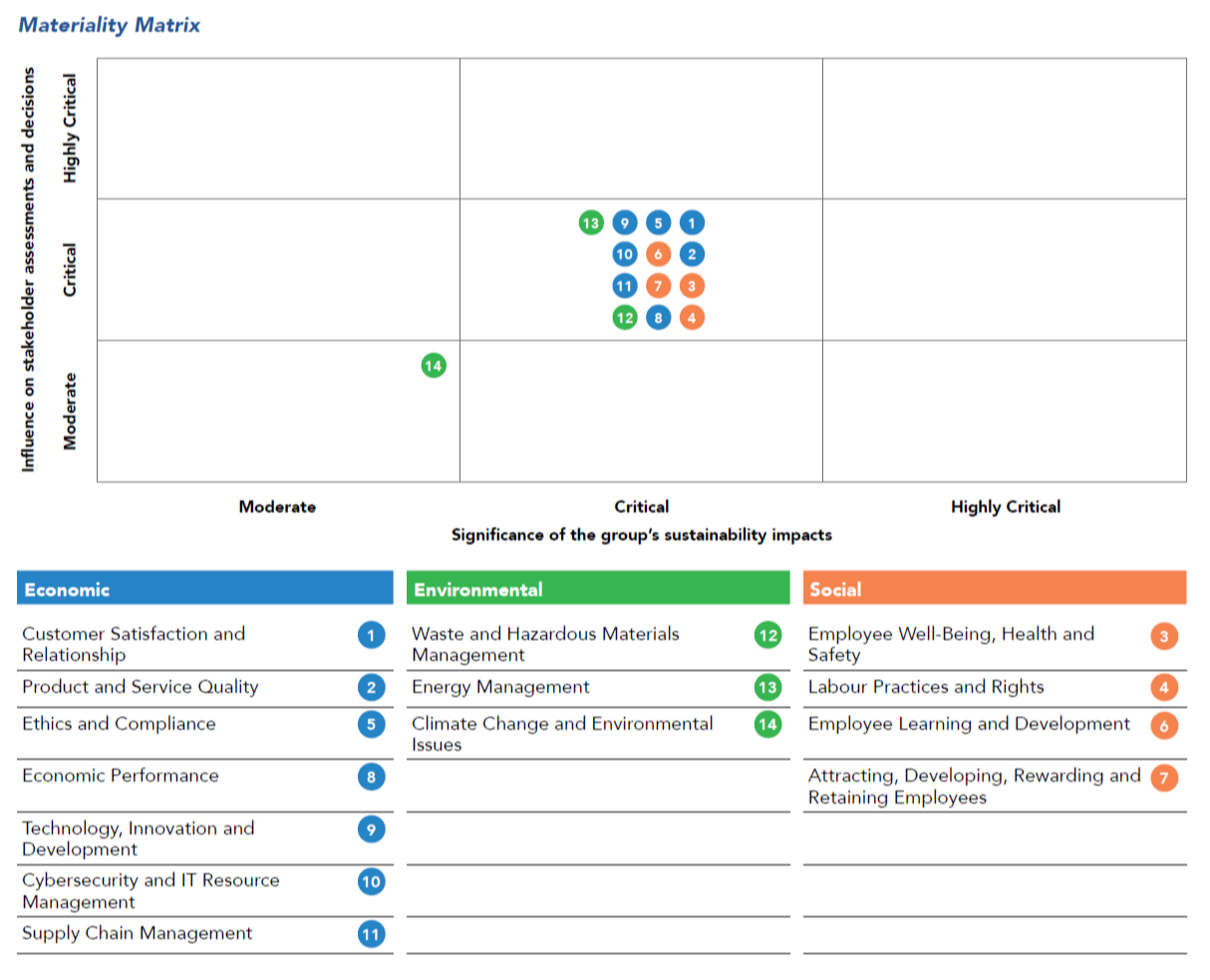
Each Material Topic was assessed and prioritised using a defined methodology that categorised them into Highly Critical, Critical, Moderate, Low, or Very Low importance levels. Based on the outcomes, 13 topics were rated as Critical, signifying strong relevance and alignment with both stakeholder interests and SAMEE Group’s sustainability impact areas. One material topic, Climate Change and Environmental Issues, was rated as Moderate, reflecting ongoing stakeholder interest while recognising its evolving maturity in the Group’s sustainability strategy.
This materiality assessment outcome highlights SAMEE Group’s strong alignment between stakeholder expectations and our strategic impact areas. The validated material topics serve as the foundation for our sustainability strategy, performance measurement, risk management, and future disclosures. They directly inform our EESG targets, operational focus areas, and reporting practices with reference to the GRI Standards and Bursa Malaysia’s requirements.